Trussell – About ending food poverty

https://www.trusselltrust.org/ Their vision is for a UK without the need for food banks. Their values are at the heart of everything they do, helping food banks in their network navigate tough decisions and support communities effectively. Trussell is based on, shaped, and guided by Christian principles. These values have strong roots in the Christian teaching […]

Christians Against Poverty – CAP

https://capuk.org/ Christians Against Poverty (CAP) provides free debt help and local community groups across the UK. Their free services, run with local churches, provide practical and emotional support and show people that there is always hope. A very practical resource showing the love of Christ to people in need.

Perspective

You may well know this bird is an Oyster Catcher and be familiar with its beautiful burbling sound but none of us can share its unique perspective as it skims low across the sea. What is your unique perspective in life at present?  In the twists and turns of life, we find ourselves in diverse places, travelling at different speeds and dealing with many types of emotion.  Here are some experiences you might be entering, wanting, dreading or leaving behind – going into the valley, on the mountain to, in the boat, on an eagle’s wing or walking on water.  Whichever one it is, you probably won’t be able to change it so the vital thing is to have the right perspective as you pass through it.

  • ‘Faith gives you an inner strength and a sense of balance and perspective in life’ – Gregory Peck
  • ‘The only thing you sometimes have control over is perspective. You don't have control over your situation. But you have a choice about how you view it’ – Chris Pine

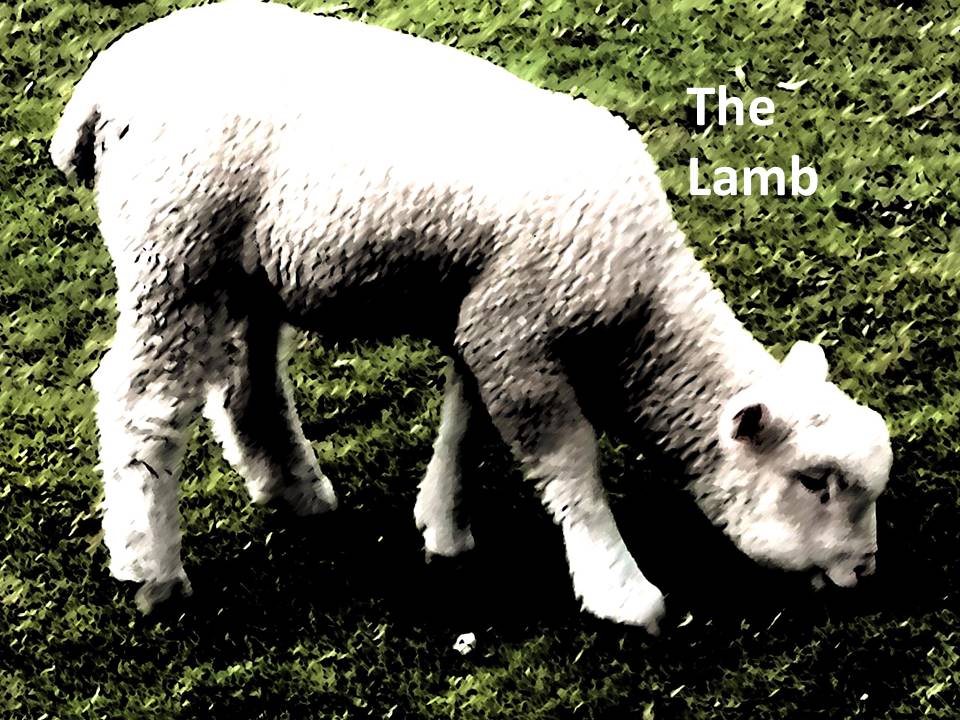
The Lamb

If you take a long look at this lamb, you will find yourself thinking all sorts of things.  You might be struck by its innocence, its powerlessness or you may wonder about its future.  This lamb has not done anything wrong, it has no defences or weapon and it may end up on someone’s plate as a favoured dish before it ever gets to be a mature sheep. Does it not strike you as extraordinary that the Most Mighty One to walk this planet Earth was called ‘The Lamb of God’? This lamb is associated with meekness not with majesty, with the Will of man rather than the Will of God. To understand why Jesus Christ, the Son of God, is called ‘The Lamb of God’ it’s necessary to consult both the Old Testament and the New – once truly understood never truly forgotten. Why a lamb rather than a sheep? A sheep is reared for its wool but a tender lamb gives its life.

  • ‘Isaac spoke up and said to his father Abraham, “Father?” “Yes, my son?” Abraham replied. “The fire and wood are here,” Isaac said, “but where is the lamb for the burnt offering?” Abraham answered, “God himself will provide the lamb for the burnt offering, my son.” And the two of them went on together’ – Genesis 22:7-8

Footprint

So much is made of the carbon footprint that we reputedly leave behind us.  Some people have changed their diets moving away from meat, have decided to use more sustainable energy sources and have become more determined to have a ‘recycling lifestyle’.   Others give it little thought as the idea of responsibility towards future generations is far from them.  Where are you on the spectrum and how have things shifted in your thinking? Turn it on its head for a moment and think about the footprint that another has made in your life – perhaps a parent, a friend or a teacher. What impact has their footprint had in your life, for good or bad?  Take another look at your own footprint in the lives of those around you.

  • ‘My mother always told me that as you go through life, no matter what you do, or how you do it, you leave a little footprint, and that's your legacy’ – Jan Brewer
  • ‘Family is very important to me because that is the footprint we perpetuate. That is, the ripple in the water when the rock first impacts the pool, and it is those waves, that energy that one produces, that determines our direction’ – Larry Wilcox

Winter

In 1623, William Shakespeare wrote a far-fetched play entitled ‘The Winter’s Tale’, borrowing heavily from the plot of Robert Greene's pastoral romance ‘Pandosto’, first published in 1588.  Part tragedy and part comedy, it spoke of the deep pain that is caused by separation and the wasted years when relationships break down. Despite the sorrow of the first three acts involving jealousy, accusation, death and injustice, things turn out well in the end.  The two fathers, Leontes and Polixenes seem spiritually dead and have lost all ability for feelings.  However, there is a resurrection at the end and joy as reconciliation comes through Florizel and Perdita in the next generation.  Winter is the season when structures are revealed as trees shed their leaves and you see their essence. This tale echoes this process in a fanciful story but God’s story does it in stark reality as relationships are redeemed through from his son’s work on a bare tree.

  • ‘I prefer Winter and Fall, when you feel the bone structure of the landscape. Something waits beneath it; the whole story doesn't show’ – Andrew Wyeth
  • ‘Even in Winter an isolated patch of snow has a special quality’ – Andy Goldsworthy

Autumn

Nowadays, many parts of the world refer to ‘The Fall’ rather than ‘Autumn’ which is easily understood as it is the time when trees shed their leaves after they change from greens to rich oranges, yellows and reds.  The origin of the word is uncertain but there is an Old French word ‘autumpne’ from the Thirteenth Century, possibly meaning ‘the drying up season’!  Maybe some people feel it is the time when the sap starts to sink but it is actually a remarkably positive time both in nature and in life.  Harvests are gathered in from Summer’s growth, celebrations are had and beautiful colours indicate that maturity has been reached.  This is a season when over 150 million people celebrate ‘Halloween’ in America, children pay ‘Conkers’ (with seeds from Chestnut Trees), there are Harvest Festivals and bonfires in Britain.  In Germany, people collect nuts, making crafts out of them and fly their kites with the strong winds that bring the leaves down. The French get very excited about this mushroom-picking season, but caution is needed for every year there are some 1,000 poisonings caused by mushrooms like this tempting ‘Amanita Muscaria’, the iconic red toadstool associated with fairies and the occult.  This is often poisonous or hallucinogenic but is sometimes eaten when boiled in parts of Europe, Asia and North America.   Various fruits still come in the Autumn but it is important to discern whether they are good or bad.

  •  ‘Autumn is a second spring when every leaf is a flower’ – Albert Camus

Summer

Whenever you read this, you will be in a season of nature and in a season of your own life.  We tend to think of seasons as a time of change as living things inevitably transition from one state to another.  Nature’s baton is handed from one season to the next and we tend to think of the first ‘runner’ as being ‘Spring’, the word coming from ‘springing time’ in the fourteenth century.  By the sixteenth century, this was shortened to ‘Spring’ describing how plants come forth from the ground (the Latin being ‘ver’ or ‘tempus primum’ as in ‘first time’).  This ‘baton of life’ is handed on to Summer which runs on at a more leisurely pace.  If Spring could suggest the morning, then Summer well conveys a lazy long afternoon and the promise of harvest. What do you associate with a Summer’s day?  Where are you in the seasons of life and the seasons of the soul?

  • ‘Rest is not idleness, and to lie sometimes on the grass under trees on a summer's day, listening to the murmur of the water, or watching the clouds float across the sky, is by no means a waste of time’ – John Lubbock

Spring

Supposing you were an artist and had a blank canvas, would you start with Spring, another season or no season? Spring sounds like a logical choice … or does it?  Its poetic speech is always of new beginnings as we associate it with the seasonal cycle that we humans have become used to.  No Spring, no Summer. No Summer, no Autumn.  No Autumn, no Winter. No Winter, no Spring.  Each one brings something different and bounces off the previous one bringing the contrasts we all love. Snowdrops herald the Spring even after the fiercest Winter – each fluttering fragile snowdrop is a little white sail symbolising the hope of gentle summer breezes.  When you feel like your life is in the grip of Winter, consider the seasons and remember that Spring cannot be far away. Our Father God is ‘The Creator Artist’ and never gets the rhythm of life wrong.

  • ‘Spring is nature's way of saying, “Let's party!”' – Robin Williams
  • ‘It is only the farmer who faithfully plants seeds in the Spring who reaps a harvest in the Autumn’ – Bertie Charles Forbes

Treatment

From an early age, we are taught to take care of our bodies and to look after the things that we may acquire.  Some do, some don’t. There are many reasons that may prompt a person towards taking reasonable care or being over-indulgent or indeed to show neglect. It has been said that some idea of a person’s character can be ascertained from their toe nails!  These hidden parts may not expect to be on public display very often so it may be possible that they reveal something about a person who either tends them carefully or neglects them.  How someone treats their toes may indicate how that person treats some other things. Take this wooden gate – if this is not soon treated, rot will set in which will seal the gate’s fate.  Proper treatment of the wood is essential for its ongoing purpose.  What would your toes or your gate reveal?!

  • ‘He who is cruel to animals becomes hard also in his dealings with men. We can judge the heart of a man by his treatment of animals’ – Immanuel Kant
  • ‘In matters of truth and justice, there is no difference between large and small problems, for issues concerning the treatment of people are all the same’ – Albert Einstein