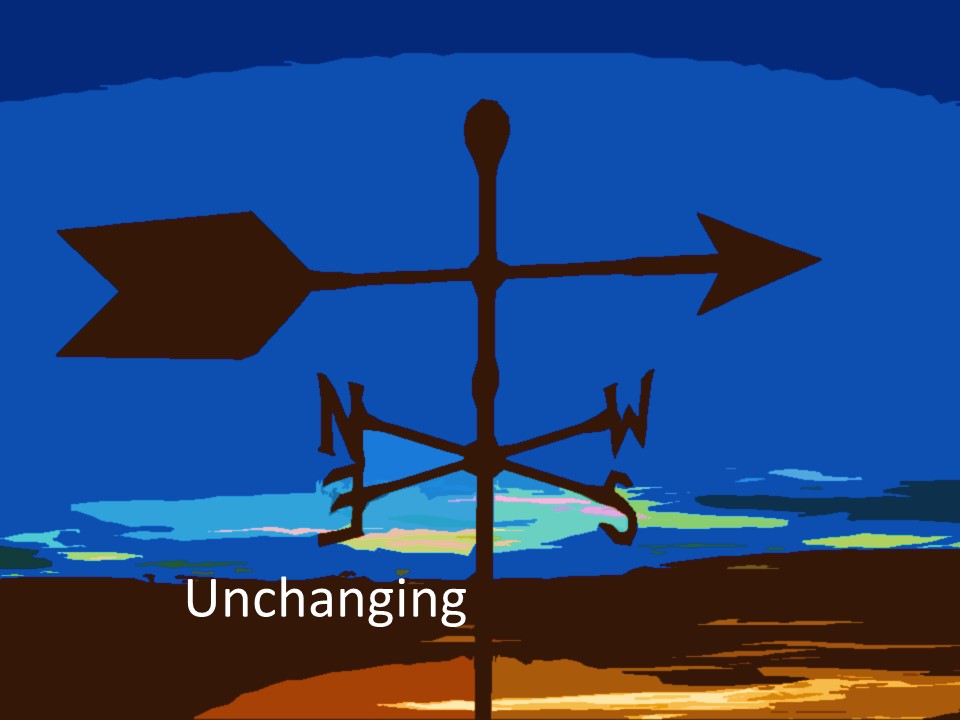
Wind and weather come together – one brings the other. What they both have in common is that they are very changeable and unpredictable even to the best red-faced forecasters. The oldest reference to a weather vane comes from China in the Huainanzi writings dating from around 139 BC. ‘Vane’ is a word coming from the Old English word ‘fana’ meaning flag. Weather vanes have been around a long time with links to Vikings, a relic from them found by archaeologists referred to as the ‘Bronze Banner’. One Gallo di Ramperto built a vane in the shape of a cockerel around 825 AD that was affixed to the top of a church tower for more than a thousand years until 1891. The DC-3 was built as a transporter aircraft by the United States during the Second World War – it takes pride of place on top of the Yukon Transportation Museum in Canada as a functional weather vane when the wind is at least 5 knots. Moving as it does with the wind, a weather vane is a good symbol for change in our volatile world. Ideas, politics, fashions, morals and technology are nomadic, always on the move. If a weather vane cannot be relied upon as an accurate weather forecaster, then something that is a fixed point is needed for safe navigation – how about magnetic north?
- ‘Change the changeable, accept the unchangeable, and remove yourself from the unacceptable’ – Denis Waitley
- ‘Those who are rooted in the depths that are eternal and unchangeable and who rely on unshakeable principles, face change full of courage, courage based on faith’ – Emily Greene Balch
- ‘I don’t believe in changing the unchangeable’ – Daniel Barenboim
- ‘Much of the world’s moral compass is broken. The moral north reads south and the moral south reads north’ – Dennis Prager
You might think magnetic north is a fixed point but it is not so. In the mid 1900s, the north magnetic pole was shifting at less than a hundred feet each day, adding up to less than seven miles of difference each year. But in the 1990s, this started to change so that by the 2005, magnetic north was moving at some 34 miles each year. There’s a science to it! Early European navigators and scientists believed that compass needles were attracted to a hypothetical ‘magnetic island’ somewhere in the far north or to Polaris (the pole star). The idea that Earth itself acts as essentially a giant magnet was first proposed in 1600, by the English physician and natural philosopher William Gilbert. He was also the first to define the north magnetic pole as the point where Earth’s magnetic field points vertically downwards which is the current definition. If there isn’t a fixed point for a farmer then the furrows that he or she ploughs will never be straight. For intrepid explorers, if there are no fixed points it costs them their lives. If you haven’t got GPS (for which you need to use common sense or else you can end up driving into a field), there’s always ‘celestial navigation’. Using the stars to give a fixed position has been used by mariners and wise men for millennia!
- ‘God made two powerful lights, the brighter one to rule the day and the other to rule the night. He also made the stars’ – Genesis 1:16
- ‘When I consider your heavens, the work of your fingers, the moon and the stars, which you have set in place, what is mankind that you are mindful of them, human beings that you care for them?’ – Psalm 8:3-4
- ‘Jesus Christ is the same yesterday, today, and forever’ – Hebrews 13:8
- ‘The God who is the Glory of Israel does not lie. He doesn’t change his mind. That’s because he isn’t a mere human being. If he were, he might change his mind’ – 1 Samuel 15:29
Our emotions can blow one way and then the other. Likewise we may vary how we see things from day to day – rights and wrongs, fact and fiction, truth and falsehood. Do people find you changeable or steadfast?
- ‘Winds from the east… Mist comin’ in… Like somethin’ was brewin’, about to begin… Can’t put me finger on what lies in store… But I feel what’s to ‘appen, all ‘appened before…!’ – Bert in the musical ‘Mary Poppins’
We may not know which way the next wind will blow or what it might bring, but we can rely on the unchanging nature of God. So in an uncertain world, look up at the stars and remember the one who made them does not change in his love for you, in his character or in his faithfulness. We cannot out-think God, we cannot escape from him, nor can we over power him. We can always depend on him and trust him for everything even when we can’t trust ourselves or others.
‘Swift to its close ebbs out life’s little day;
Earth’s joys grow dim; its glories pass away;
Change and decay in all around I see;
O Thou who changest not, abide with me’